
Francois Truffaut states...
"A true film auteur is someone who brings something genuinely personal to his subject instead of producing a tasteful, accurate but lifeless rendering of the original material."
What Francois Truffaut means by this quote is that to be a "true film auteur" is to put yourself in all of your works (not as in literally but metaphorically, an example is a trait or personality from the film director that is interpreted in their work). Doing this makes your work truly personal, sometimes doing this requires the film director to accept that their work isn't going to be as popular as a blockbuster film is. In a sense what Francois is saying is that to make art (mostly films but this can also work for the medium in general) that is truly special, the creator should make it personal. While saying this he also subtly calls out some movies that are adaptations of other media a "lifeless rendering of the original material"
Problems with Auteurs
Auteurs are always fighting an uphill battle when it comes to making their films. Even before the rise of blockbusters and the constant churning out of those movies, studios would still be hesitant to invest in an auteurs film simply because they didn't think there would be an audience for the films they wanted to make. This still happens when their films get greenlit as well, sometimes a studio executive would step in and tell the director that they couldn't do something the director wanted to do. This leaves the auteur with two options: either back down and stray further away from their vision of the film or argue with the studio.
However it also goes the other way as well. An article on Studiobinder states "...there is a limit to what the Director's power should be. Without checks and balances in place, things can veer into disaster." Too much creative liberty is also a problem, at the end of the day the director needs to make the money back to the studio otherwise their film will be unsuccessful. This is what happened with Michael Cimino's Heaven's Gate. He was an auteur most famous for directing The Deer Hunter, however his next film went so over budget over minor details and footage that ended up not being used anyway. Being so particular with everything also slowed the production down heavily, he was five days late and after burning through $900,000 he only filmed a minute-and-a-half that could be useable as footage. When the film finally came out it was a complete failure, caused the studio backing it to go bankrupt and completely ruined the directors reputation. While the auteur theory praises certain film directors for their creativity shining throughout all their works, there is a reason why studio executives are there
Another way other people can cause problems for auteurs is because of how they're so highly revered for their specific style, they might also feel pressured to have to stick to that style forever. Auteurs are meant to have a personal connection with their films but people do change and some auteurs may eventually no longer feel attached to their style of film. In this light being an auteur may be as much of a curse as a blessing: while you may be seen as one of the best film directors ever in the eyes of many, your audience will feel alienated if you try to do something different with your work
One of the more quieter problems about auteurs is that because the film director is the only one the general public cares about and they attach them onto the movies they make so strongly, the other people who worked on the film aren't credited. While the film director was guiding everyone through to make sure everything for the film was how they wanted it to be, at the end of the day they weren't the one who actually did everything. This is also a problem for films in general, while they are in the credits people don't pay attention to them nearly as much as they do with whoever directed the film
Barber, N. (2015) Heaven’s Gate: From Hollywood disaster to masterpiece. Available at: https://www.bbc.com/culture/article/20151120-heavens-gate-from-hollywood-disaster-to-masterpiece. Accessed at: 06.09.22
Studiobinder. (2019) Auteur Theory: The Definitive Guide to the Best Auteur Directors. Available at: https://www.studiobinder.com/blog/auteur-theory/. Accessed at: 06.09.22
Would you consider Quentin Tarantino an Auteur?
In my opinion Quentin Tarantino is an auteur
MasterClass defines an auteur as "a director who exerts a high level of control across all aspects of a film. (...) generally have a distinctive style from film-to-film and often fill other roles besides directing including: writing, editing, and sometimes acting in their own films."
Tarantino is heavily involved in every film he makes, throughout pre-production to post-production he's always telling people exactly how he wants things to be. He sits with his editor, wrties his own scripts and he did actually act in one of his films (even if it was the first one he ever did)
There are also three main rules to being an auteur: technical skills, a distinctive style throughout all their movies and interpret themselves in their own work. These rules were coined by Andrew Sarris, a critic who expanded on the ideas Francois Truffaut talked about in his article "A Certain Tendency in the French Cinema"
Tarantino also has these, his movies are well known for their graphic violence and revenge stories, specifically stereotypically 'weaker' characters taking revenge on someone (Kill Bill is about a woman soon-to-be-mom who violently kills the organisation Bill is in charge of to kill him, Django Unchained is about a black man killing racists and the very people who enslaved him, ect.). He's a very hands-on director and we know every single shot and frame in his movies were planned by him. While this might not completely prove the technical skills rule, I think its still important to point it out that he's the one that decided how the film was ultimately presented. He's also the one who writes all of his films as well, something he's won two oscars for
It also helps that hes a famous example for an auteur, on Google he's one of the first people who comes up as a result when you search 'auteur'
Business Bliss Consultants FZE. (2018) Quentin Tarantino Auteur Theory. Available from: https://ukdiss.com/examples/auteur-theory-quentin-tarantino.php. Accessed 06/09/22
MasterClass. (2022) Film 101: What Is an Auteur? Learn About Auteur Theory. Available at: https://www.masterclass.com/articles/film-101-what-is-an-auteur. Accessed at: 06.09.22

Daily Diary 06/09
Today I learnt about auteurs, what they are, the word's origins and a film director who is a popular example of an auteur, Quentin Tarantino. Learning about what an auteur is will obviously be very important for when I have to copy an auteur's style later on and make a video about the topic
I think the Francois Truffaunt quote is interesting since its an opinion on art in a sense and that's one of the many points of art. I don't know who will be the auteur I choose mainly because I don't really watch films so I don't know any (and because this will be a collaborative effort as well)
While writing about if I think Tarantino counts as an auteur or not, I realised I didn't really feel anything much about the word itself. I completely understand why auteur is a term and I get why there's a distinction from that and a regular film director, but at the same time I can't help feel that this argument is a little pointless at the end of the day. "Would you consider Quentin Tarantino an Auteur?" Yeah sure but what does that really change? Does it really matter if he is or not? The films are still the same at the end of the day, to me I feel like the term auteur would mainly be used by film snobs who say they only watch films by auteurs and no one else because their work is what true art is or whatever. It's very limiting to me because I feel in a way every film director puts a little bit of themselves into their work, thats what naturally happens when you have to work on a project for a while. Maybe they don't have reoccuring themes all the time like Tarantino does but in a way I think thats better, I like revenge stories a lot but I can't imagine being stuck writing them for the rest of my life
Reservoir Dogs

Reservoir Dogs is a film about a group of five men who unsuccessfully pull off a heist. Some of them suspect that they've been set up by an undercover cop while others don't believe its true until the later end of the movie. After the opening its shown that one of the men has been injured with a bullet wound, showing the plot aligns with Tarantino's trait of this film being a revenge story. There's also a big theme of distrust throughout the movie as the criminals who did the heist can't even trust each other, this goes so far as to the characters going by codenames that are associated with colours
Mr Brown is played by Tarantino (one of the features of an auteur is that they often play a role in their own movie) however he isn't seen after the opening where they argue over if people should tip people who work in customer service. Its revealed quickly that he died offscreen. This might be a literal sign of the literature criticism called 'death of the author'. Death of the author is when someone removes all of the 'authors' intent and political ideals from their work. This might be a sign of how Tarantino doesn't agree with the main cast of the film, specifically with how Mr Pink treats people who do customer service. Tarantino has worked in customer service before as he worked at a blockbuster
The film, like most Tarantino films, is told in a non-linear fashion. The audience doesn't learn how Mr Orange got shot, only until Mr White and Mr Pink are talking about it themselves do we get to see the scene them running away. In a similar manner there are many times where upbeat songs are used in completely 'strange' scenes, its especially apparent during the torture scene and the lead up to it as one of the characters dances to it while torturing someone. This might be a way to elevate how dark and graphic the scene actually is, or just a way to add some comedy into the film
Speaking of the torture scene, there are many scenes of violence in the movie. The main cast often fight each other and someone else always has to break them up from it, happening at least three times in the entire movie. The first fight was between Mr Pink and Mr White, Mr Pink was annoyed at Mr White for not acting 'professional' enough and had to tell him multiple times not to reveal his name to him. It gets broken up by Mr Blonde, but a fight between him and Mr White almost happens as well before Mr Pink quickly stops it. Because of all of this distrust between each other, eventually all of them except Mr Pink end up dead. The actual torture scene itself is quite graphic and frightening as well, the cop gets his ear cut off and gets doused in gasoline as he's about to be lit on fire
The film is a crime film that also ends up being a mystery as the film progresses. The crime aspect is obvious as the main cast are all criminals (excluding the undercover cop). They wear business suits throughout the whole film, act violently and say slurs and swears very openly. The opening of the movie is the main characters walking in slow motion, an effect that's common in many crime movies. Most of the movie is shot in the same few settings (dull warehouse, bathroom, outside, in a car and a few other settings which are only used once throughout the film), which is common for a B-movie. The warehouse is where most of the movie takes place and is a dull and almost abandoned looking place, which makes sense as this warehouse is owned by Joe (the boss) and is meant to be a secret from the public. Most of the scenes also have harsh shadows and light, the only setting that doesn't have that is outside. The outdoors are notably more bright than the other settings, especially during the scene where it cuts between Eddie in the car and the cop being taken into the warehouse. This was probably done to add comedy to the scene and leviate the violence
Throughout the film, the characters criticise how emotional Mr White is, Mr Pink is the one who does this the most and they fight over it. Mr Pink constantly talked about how they're supposed to act professional and about how they should focus on getting revenge on whoever was the undercover cop, he also told Mr White multiple times that he's not supposed to reveal his name to him. Whenever Mr White gets emotional over what happened to Mr Orange, Mr Pink goes at him for not acting professional enough, even when Mr White explained that he was the reason Mr Orange got shot. The constant pressure for professionalism from Mr Pink is a sign of toxic masculinity as its his way to keep complaining about how Mr White is crying over this, not that he doesn't complain to him about being emotional outright. Mr White also gets called a dog repeatedly by Mr Blonde, a common insult the characters use whenever others fight. The only dog seen in the film is the one with the police so they might associate them with cops. No one in the film treats dogs nicely either. The main cast also call women 'bitches' frequently and use the n slur as a replacement to call each other dogs when they fight, alluding to a theme with dogs
All of the songs used in the film are actually very upbeat and are only played during specific moments. The first song at the opening is an upbeat song that after the opening quickly stops. Another song plays during the torture scene and its another upbeat song, this one is diegetic as it comes from the radio Mr Blonde plays. Other than that and the main credits though, there isn't much music in the film. A lot of the film is ambience and the silence is usually filled in with characters talking to each other. The ambience might be a way to add suspense and give more weight to what the characters are saying, especially when they yell at each other, as there isn't any music to distract the audience
The ending is a little interpretive as to what happened. Mr White clearly dies but because the camera is so close to his face, we don't know if he shot Mr Orange or not. There are gunshot sounds before Mr White dies but those might be misfires or warning shots from the cops. Either way Mr Orange was most likely dead anyway as he was still shot earlier in the film, while talking to the cop Mr Blonde tortured he shouts at him because he knows he's going to die
Mr Pink stashes the diamonds in a briefcase that we never actually see in the film. He's also the only one of the main cast who lives in the end since he runs before the cops show up to the warehouse. Detective Holdaway tells Mr Orange while he's preparing to infiltrate the main cast "This story revolves around you." In a way he's right as the story of the film is about trying to find the undercover cop
Cultural Reader. (Year unknown) Short summary: Death of the Author - Roland Barthes. Available at: https://culturalstudiesnow.blogspot.com/2017/02/roland-barthes-death-of-author-summary.html. Accessed at: 07.09.22
MyTutor. (Year unknown) What is "The Death of the Author" and why has it been so influential in literary criticism?. Available at: https://www.mytutor.co.uk/answers/37763/A-Level/English/What-is-The-Death-of-the-Author-and-why-has-it-been-so-influential-in-literary-criticism/. Accessed at: 07.09.22
TV Tropes. (Year unknown) Death of the Author. https://tvtropes.org/pmwiki/pmwiki.php/Main/DeathOfTheAuthor. Accessed at: 07.09.22
Daily Diary 07/09
Today I watched Reservoir Dogs and made notes on the movie as I watched it. Making notes on the movie will help me for when I have to write an essay. While I can't compare this to his other movies yet, its a good starting point and I know that as I watch the films I'll be able to later
I don't really have much of an opinion on the movie itself, it was fine enough. Around half-way I realised the movie just wasn't for me really but I kept watching anyway to make notes on it. I didn't watch any movies in class last year (something my brother said was weird because he did) so I appreciate that we're doing that now. I've never seen any Tarantino films myself but I did recognise Django and obviously Pulp Fiction, so I'm curious to see what those are like. It makes sense how I've never heard of Reservoir Dogs since its one of Tarantino's first movies and since parts of it just don't hold up well today
Pulp Fiction

Pulp fiction is about a series of scenes with different characters that don't seem related, but eventually connect with each other to create a coherent storyline in the end. The film is a crime film with heavy black comedy. The black comedy mostly comes from the heavy violence and drug use in the film
The non-linear storyline of the film is a staple of Tarantino films, the opening of the movie is actually part of the final scene in it. Afterwards it then cuts to two seemingly unrelated characters. One of the things that makes this part of the movie stand out from other Tarantino films like Reservoir Dogs is that it keeps switching to new and different people, making the narrative more confusing to follow at first
Another Tarantino staple that is prevalent is the violence and revenge aspects of the film. Unlike Reservoir Dogs the deaths in this film feel more comedic because of the tone, such as two men getting shot in the dick and the man who accidentally got shot in the car. There's a rape scene in the film which ends with Butch and Marsellus killing the people who put them there, agreeing to never talk about it
There are two other themes in the film as well. The film contains heavy usage of drugs and religion with Jules. Vincent and Mia specifically are often seen smoking or taking drugs. The drugs are used in a more comedic way after Mia overdoses, having to be driven over to an unwilling person and stabbed in the heart with adrenaline to stay alive. Jules is obviously a religious man as he recites Ezekiel 25:17 often in the movie, he also wears a necklace with Jesus' cross on it. Its a more minor theme but he does a speech about it at the end, realising that this whole time he was "the selfish and the tyranny of evil men" in the passage
The songs are similar to Reservoir Dogs, being 'trashy pop' songs. The opening song 'Pump It' is played after the couples start to rob the diner, an energetic song. Later on in the middle of the opening the song switches with a radio sound effect to a different song, that song is then the one that plays in Jules and Vincent's car. This makes that song in the movie diegetic as the characters can hear and change it
Like in other Tarantino films, the characters naturally swear a lot in the movie. Sometimes so much so that its comical like with the scene of Vincent and his drug dealer trying to help Mia. There are also more slurs said in this movie than in Reservoir Dogs, but the majority of them come from people who can reclaim them. In general Tarantino seems to be someone who doesn't really care about slurs, for example while working with his typist Chen he often called her a slur. The only time the n slur was said by someone who wasn't black in the movie was by the character Tarantino was playing. The camerawork was also clearly directed by Tarantino, there are a few 360 shots in the movie that go around a character and a long corridor shot at the beginning while Vincent and Jules were talking
There are many similarities between Pulp Fiction and Reservoir Dogs, both movies start with people talking in a diner. Tim Roth, the actor who was the undercover cop in the previous movie, plays a criminal called Ringo. While talking with his lover about their thievery he jokes about robbing a bank, which was something his character in Reservoir Dogs did. Vincent Vega is related to Mr Blonde (Vic Vega) from Reservoir Dogs and was supposed to be played by the same actor, but Michael Madsen was set to star in a different movie called Wyatt Earp at that time (a decision the actor regrets). Harvey Keitel, who played Mr White previously, was the cleaner who helped Jules and Vincent in this film. Many other actors got their start up with Tarantino from Pulp Fiction as well: after this film Samuel L. Jackson was in other Tarantino films like Jackie Brown and Django Unchained and Uma Thurman was later the starring role in Kill Bill. Kill Bill specifically was offhandingly mentioned in this movie before it even came out
Throughout the movie Vincent and Jules are carrying a briefcase to their boss, Wallace. A few characters do but the audience never sees whats in the briefcase, leading some fans to speculate that its the diamonds from Reservoir Dogs. One of the settings in the film is a nightclub that looks similar to the one briefly seen in Reservoir Dogs, both Vega's also own a nightclub together
Bhattacharya, S. (2004) Mr Blonde's ambition. Available at: https://www.theguardian.com/film/2004/apr/18/features.magazine. Accessed at: 10.09.22
IMDb. (Year unknown) Harvey Keitel. Available at: https://www.imdb.com/name/nm0000172/. Accessed at: 10.09.22
IMDb. (Year unknown) Samuel L. Jackson. Available at: https://www.imdb.com/name/nm0000168/. Accessed at: 10.09.22
Seal, M. (2013) Cinema Tarantino: The Making of Pulp Fiction. Available at: https://www.vanityfair.com/hollywood/2013/03/making-of-pulp-fiction-oral-history. Accessed at: 08.09.22
Daily Diary 08/09
Today I watched Pulp Fiction and made some notes on that film. Like with Reservior Dogs watching this film will help me with writing my essay. Because I've now seen two movies, I was able to make comparisons with them that I can talk about later as well
I know that this film is a cult classic and I've heard about it previously but never really knew anything about it, after watching it I think I get its cult status but still feel like it's fine enough. My favourite scenes were with Vincent and Jules because of how comedic they were together and I like Jules as a character the most, but I didn't really care much for the Bruce storyline in the film. I was surprised that Mia didn't appear in the film much as she was a big part of the promotional matieral, I found it to be a bit of a shame as from what I saw I liked her character. On the whole I enjoyed the film a lot more than Reservoir Dogs and think it aged much better than that film, but I doubt I'll ever watch it again. I don't like needles that much (which is heavily present in the overdose scenes) and while the rape scene isn't extremely graphic, I'm someone who believes that unless there is an extremely important reason for having rape in a story then its never needed
Django Unchained

Django Unchained is a movie about Django, a previous slave, suddenly being given his freedom and going to a plantation to save his wife from slavery as well. The film is a blaxploitation with heavy spaghetti western elements and action as well
Unlike the previous two films, Django Unchained doesn't have a non-linear storyline and we see how Django becomes free to how he saves his wife in a very linear fashion. Instead there are flashbacks to certain things, when Django tells King what his wife looks like we get a flashback to her and Django getting seperated. These flashbacks happen multiple times in the movie, there's one where Django gets flashbacks to seeing his wife run away and get hit for it while a slave infront of him gets hit for the same reason and while King is thinking about it we see a flashback (of a scene that wasn't shown previously but only implied) of a slave getting mauled by dogs as a punishment for losing a fight
To make up for going against Tarantino's usual traits, there's a lot more violence and revenge is the main plot in the movie. Django is ultimately an underdog story about a slave getting revenge on racists and slave owners who mistreat him, so the revenge aspect is obvious. The violence in the movie is also a given as many people die due to them being racist to Django or for mistreating him in the past. There's a scene of Django's wife getting branded with a hot iron and another scene where two slaves try to beat the other to the death while other people watch, the camera lingers on their fight most likely to make the viewer uncomfortable. Django's wife has her life threatened multiple times once they realise she's important to Django, at the table she has her hair pulled and blood wiped on her face and later on Django stops shooting people because he doesn't want her to die
There are two other themes in the movie as well, a very minor one is where King tells a tale of German folklore to Django to inspire him to save his wife despite how dangerous it'll be. The other theme is of black people who align themselves with and defend slave owners, this is mainly seen with the servant and and Django himself (although he was doing it to not blow his cover). There's a house slave (played by Samuel Jackson, the same person who acted as Jules from Pulp Fiction) who has a very good relationship with Candie despite being black. When Candie tells Stephen (the house slave) to accomodate a room for Django he actively opposes what he's being ordered to do, implying that he hates his race even more than Candie does. Stephen is also the only reason Django and King's plan fails as he finds out and tells Candie what they're really for, something thats ironic considering slave owners considered black people to be dumb. This was, and in a way still is, a prevelent problem many black people face when getting exposed to racism. People can inevitably come to the conclusion that this injustice is deserved and even go as far as to treat their own race with as much hatred as racists do. Another character who's like this is Uncle Ruckus from The Boondocks. Django himself shouts at slaves while travelling to candyland with Candie, going so far as to stop King from saving a slave from being brutally murdered in front of him. While we know that King was traumatised by this, Django didn't show much remorse himself which might be because he's used to seeing it. Its shown that he's seen slaves getting punished before with the flashbacks of his wife
The setting at the beginning leans heavily into spaghetti western. After being free Django gets taken to a town with a wild west theme, with it even having sherrifs. Django gets a sherrif-like outfit later on as well. In the middle of the film there's a montage of Django repeatingly practicing doing a quick draw and firing, something that pays off later on, which is a clear cut code and convention of spaghetti western. The sound effects and music also fits, for example there's a shot where the camera zooms in on Django's face turning to it as a 'whip' sound effect plays and another where a violin plays as Django rises up. In the sequence after King is shot, when Django shoots people the music goes with the gunshot sounds. Out of the three movies watched this easily has the most songs played and they all fit the western theme. There are some famous western classical music prevalent in the film such as Für Elise by Beethoven, many of the songs used in the film are used in other spaghetti western films ("The Braying Mule" and "Sister Sara’s Theme" are both from Two Mules for Sister Sara and John Lennon's song "Who Did That To You?" is used as well) and the song in the opening is a song that features the titular character's name as it was originally from the film Django (1966)
The beginning of the film has very harsh shadows to set the tone of the film, it's also very dark due to it being late at night. There's a brown tone to the movie as well (the town Django and King briefly go to and the shots of the rocks at the beginning) which helps with the western theme and also might be a nod as to what the film is about. Another western trope in the movie are wide shots of carridges and horses moving with a sunset behind them. Contrasted by the dull hues are the plantation sites, they're much more vibrant and colourful. While at a plantation site Django also wears a very vibrant blue outfit, making him completely unmissable and stand out more. The Tarantino staple of a 360 degree shot is in the movie, an example being the scene where Stephen is talking to Candie about what's really happening
The language used in the film is much more vulgar due to the nature of the film. Slaves are often referred to as devils during the beginning and Candie himself calls them and Django "boy" often, later on saying that the slaves need "adult supervision" when Stephen calls him away from the table. This is an obvious way to belittle them while making himself look more distinguished. Django calls Stephan "snowball" which is most likely meant to be a jab at how close he is with Candie. Its also mentioned to Django to not speak French to Candie as to not embarrass him, but at one point in the film he speaks a bit of French to him seemingly as a way to get at him. There are a few scenes where Django says something he knows will anger someone else (usually Candie) as well, but the situation usually gets diffused quickly. After Candie finds out about Django and King's plan, he has a speech about scientific racism to justify slavery which was a very common notion during the time period the movies set in. The theory he talks about is most similar to the one in Samuel George Morton's Crania Americana, the most infamous racist theory, as that talks about black people and Native Americans having 'different skulls' from white people. King while on the spot gives Django the last name "Freeman", which is a very literal meaning as to what he is
All three of the Tarantino films watched all have a scene of characters talking in a bar about their future plans. The main cast in Reservoir Dogs talk about their planned heist, Jules talks about how he's going to quit his job and King and Django talk about their plan to save his wife. They also all have an on-screen torture scene (Mr Blonde with the cop, Butch in the pawn shop and the many scenes of slaves getting hurt) and a scene of three people in a standoff with guns pointing at each other (Pulp Fiction is the only film out of the three where no one in the standoff shoots eachother). A fan theory thats been proven to be true by Tarantino states that all three of these films are in the same universe
Grace, Z. (2022) Tarantino Movie Fan Theories That Could Actually Be True. Available at: https://www.looper.com/152819/tarantino-movie-fan-theories-that-could-actually-be-true/. Accessed at: 12.09.22
Lewis, R. (2012) Quentin Tarantino discusses the music of ‘Django Unchained’. Available at: https://www.latimes.com/entertainment/music/la-xpm-2012-dec-25-la-et-ms-quentin-tarantino-django-unchained-music-soundtrack-streaming-20121224-story.html. Accessed at: 12.09.22
University of Cambridge. (2014) Skulls in print: scientific racism in the transatlantic world. Available at: https://www.cam.ac.uk/research/news/skulls-in-print-scientific-racism-in-the-transatlantic-world. Accessed at: 12.09.22
Quentin Tarantino Auteur Stylings
Daily Diary 13/09
Today I watched Django Unchained and made notes on the film as I watched. Now that I've seen all three films I'm able to spot patterns and tropes within Tarantino's films. Watching and making notes about three films helps me a lot with my essay as I'll have to be comparing and showing similarities about them later
This film is complicated to me. It's definitely above Reservoir Dogs, but the film is stuck in this weird sense of limbo. Like Pulp Fiction, I was interested enough to keep watching but I don't really feel much for the film and will probably never watch it again. I liked King the most since I found him funny but I'm fine that he died, when he first appeared in the film I was very worried the film would go to the white savior route and the worry lingered on for the rest of the movie up until his death
One thing that sticks out to me heavily is that this film is a blaxploitation film. I vividly remember scrolling through Netflix with my brother and him saying he avoids most things with a black lead as they're usually depressing and while I obviously don't agree whole heartedly, I find it extremely sad that he's not completely wrong. Its upsetting that when it comes to films with black leads a lot of them are about slavery or racism, I want more representation than just misery. I don't hate blaxploitation films as a whole and I can recognise that there is a place for these films, but I'm just not interested in seeing them personally. I imagine its a bit like showing Saving Private Ryan to a war veteran, I really don't need a movie to show me that racism exists
The biggest reason for my opinion on the movie being soured is that most blaxploitation films are made by black people for black audiences, but this one is made by someone who very much isn't. While yes Tarantino is 'starting a conversation' with this movie, at the end of the day he's the one who's profiting off a blaxploitation movie. A part of it might also be the fact that its him doing it of all people, while I don't think saying the n slur automatically makes someone racist I heavily dislike how casually he seems to say slurs and how they're all said by white people in Reservoir Dogs and Pulp Fiction (especially in Pulp Fiction, it sort of took me out of the film when he said it so casually with the r at the end three times in quick succession). I also find it funny how in the movie he plays an employee for the company that Django was sold off to and is the first person there who listens to him. If it meant anything at all then this was probably meant to be an "I'm also going to hold myself accountable for my ancestors" moment or whatever if I had to guess and I found it funny in a way he probably didn't intend the first time I saw it
When I heard the first n slur in Reservoir Dogs I decided I'd keep count of how many times its said in these films as a joke, completely forgetting about Django Unchained. In total counting all three movies its said 130 times (4 in Reservoir Dogs, 11 in Pulp Fiction and 115 times in Django Unchained), discounting Django Unchained for obvious reasons only 8/15 is it said by someone who can actually reclaim the slur and all of those are only from Pulp Fiction. I'm aware that basing my opinions on the films by this isn't great and that it was a different time but I'm allowed to like the films (and Tarantino himself since its clear I'm not really a fan of the guy) less because of this
Movies That Made Me: Quentin Tarantino
Tarantino was interviewed on a BBC show called Movies With Ali Plumb. In the interview he talks about his own movies, their impact on pop culture and a few of the mistakes in the movie. Unlike other interviews Tarantino has been a part of in the past (specifically the channel 4 interview), Plumb has very friendly conversation with Tarantino and makes him seem less serious in the process. It also helps that Plumb makes himself known as a fan of his work. The last question is about how fans talk to Tarantino and he says they usually talk about how much his films meant to them
When asked about his impact on pop culture, Tarantino said he was surprised about how many films and shows have references to his own. A few examples like the Reservoir Dogs reference in The Simpsons, the Kill Bill reference in Shrek and the Pulp Fiction reference in Captain America: The Winter Soldier were mentioned. "Battles Without Honor and Humanity" is a song that's used a lot because of Kill Bill popularising the song. He talks about one of the mistakes he made in his own film, in Reservoir Dogs there's a moment where the microphone is visible in a shot, which was interesting as directors talking about visible mistakes like that in their film is uncommon
BBC. (2019) Movies With Ali Plumb. Available at: https://www.bbc.co.uk/iplayer/episode/p07jzhgw/movies-with-ali-plumb-movies-that-made-me-quentin-tarantino. Accessed at: 13.09.22
Channel 4 News. (2013) Quentin Tarantino interview: 'I'm shutting your butt down!'. Available at: https://www.youtube.com/watch?v=GrsJDy8VjZk. Accessed at: 13.09.22
Daily Diary 14/09
Today I watched an interview with Tarantino, made a few notes on it and finished my essay plan
Working on all of these will help me a lot for when I have to actually write my essay, especially as my essay plan is very thorough and breaks down the three main points of the essay (introduction, main body and conclusion). I had a little bit of trouble with properly structuring the essay as I've never really written one before, but I know I'll be able to ask for help with it later on
Research
I wanted to look at interviews so that I'd be able to write a biography on Tarantino's life and tell why he does the things he does with his movies, I chose it to be the first thing I researched though because I felt it was the subject I had the least info on. I first read an interview that was in a 1994 issue of Film Comment (making Pulp Fiction his most recent film at the time, this is important as the interview mainly talks about that film and Reservoir Dogs only). The interview doesn't start until a little later into the article
When asked about the balance between realism and comical in his movies, Tarantino says "That’s this mix that I’ve been trying to do. I like movies that mix things up." He purposely adds moments where its both intense and hilarious like the torture scene in Reservoir Dogs. He also mentions that in that film that there is a real-time clock to it, "The movie takes place in the course of an hour. (...) every minute for them in the warehouse is a minute for you."
The interview goes into the thought of the characters in the film playing a "role" in some sorts, the two examples given are when Jules says "Let's get into character." and the scene of Jules and Vincent at Jimmy's house being likened to when a child tries to cover up something they did before their parents find out. Another quote to support this is said later on in the article, Tarantino mentions that "The characters have a commitment to their own identity". It also talks about how his movies are theatrical, while talking about Reservoir Dogs Tarantino states "To me, the most important thing was that it be cinematic."

Ultimately the interview is mainly about his camerawork and movies in general instead of him, so I decided to stop reading it for now. I might revisit it though as talking about his shots in his films and how he comes up with them will most likely be important later. Afterwards I found out that there's a book called "Quentin Tarantino: Interviews, Revised and Updated" which sounded exactly what I was looking for
On page 83 the book briefly talks about Tarantino's life. He's a self-taught filmmaker. He grew up in Los Angeles and was the only child of a single mother who was at the time going to college, in his childhood he wanted to be a starring actor in movies. Growing up he was bad at school, not interested in sports and deeply loved comics and films. He loved horror, exploitation and crime films. A few of the films he talks about are Caged Heat (1974), Breathless (1959), with his favourite being Bande à part (Band of Outsiders, 1964). He named his company after it as well - A Band Apart Films
He ended up watching Once Upon a Time in West (1968) just when he decided he wanted to be a director, he calls the film "... like a book on how to direct." He also had a few huge influences when it came to directing: De Palma, Godard, Sergio Leone and Howard Hawks. Pauline Kael was a film critic Tarantino admired when he was sixteen and he bought all of her books. She unfortunately retired when Reservoir Dogs was in the middle of production, but Tarantino replies "But maybe it's for the best. Maybe I really don't want to know what she thinks of the movie." At one point, before he became a director, he worked at a local Blockbuster
While writing my essay I decided I should do research on one of those directors and see what they're known for, I decided to choose De Palma specifically as he seemed to be Tarantino's biggest inspiration (he's the one talked about most often). Brian De Palma is a director who makes "thrillers that were both stylish and violent" according to Rotten Tomatoes. His movie adaptation of Carrie, Stephen King's first novel, was a graphic horror that featured a famous scene using fake blood. John Travolta had starred in one of his movies, Blow Out (1981). When his film Scarface (1983) was released, it was rated X due to its graphic violence
I also read another interview with Tarantino, the one with Vanity Fair. I read it to try and get a quote that mentions how he likes to be in control of his films. There's also an instance of Tarantino talking about working at Video Archives (a premier video store in Southern California), "People think I learned about movies because I worked there, but I worked there because I knew about movies." I didn't get anything else out of it though
I was able to find a Youtube video of Jamie Foxx talking about his experience working with Tarantino though, I originally found it on an article on ranker.com that had a link to the video. He calls Tarantino a "tyrant" and talks about how when he was first acting he was pulled aside by Tarantino and was told to change his acting style. One of the interviewers asked “Tyrant in the sense that is he insistent on every word being just the way he wrote it?” and Foxx replied “Oh yeah, but that’s what you want.”
As I wanted a segway between Jamie Foxx and other actors Tarantino's worked with, I quickly looked at a few IMDb pages. I had remembered most of them (like Uma Thurman) but I still wanted to check anyways. I already know that Tim Roth plays Mr Orange in Reservoir Dogs and Ringo in Pulp Fiction as I've seen those movies, but he also plays Oswaldo Mobray in The Hateful Eight. I also know Samuel Jackson plays Jules Winnfield in Pulp Fiction and Stephen Warren in Django Unchained for the same reason, he's also Ordell in Jackie Brown and the narrator in Inglourious Basterds. He's Big Don in True Romance, a film written by Tarantino but not directed by him. Aside from Zoë Bell who is a stunt double, Jackson has starred in the most Tarantino films. I wanted to do a quick comparison with another auteur about how auteurs often appear in their own movies, so I quickly looked at Alfred Hitchcock. Its debated how many of his movies he actually appears in, but out of his 50+ films he's at least in 36 of them
While researching, I found an interview Tarantino did talking about cinematography. In it he criticises Roger Deakins and how he use digital cinematography. As he sees it, anyone can be a cinematographer because they can take any scene and edit it in post. When talking about his own cinematography he says "I like cinematography where what you see is what you get is what you do on the day." I might be able to use this when talking about how he's an auteur as the quote implies that Tarantino is purposeful with his own cinematography, in the video he mentions the lighting in his films as well
When I had to talk about what Tarantino is currently doing now, I realised off the top of my head I didn't really know. I did some research and I first found an article on Hollywood Reporter. There's a Tarantino quote in it that states “If you think about the idea of all the movies telling one story and each film is like a train boxcar connected to each other, this one would sort of be the big showstopping climax of it all,” he said. “And I could imagine that the 10th one would be a little more epilogue-y.” He says his 10th film will be his last (Kill Bill Vol 1 & 2 is counted as one film) but no one knows what it'll be. That article linked to another one on the same website, I looked at that one as well but it didn't say much else
I found another article called Tarantino Is So Secretive About His Final Film, Samuel L. Jackson Doesn't Know if He Has a Role. The article doesn't have much else besides the title, but I'll include it in the essay since it emphasises the mysteriousness of Tarantino's final film
I had previously seen a few clips in previous sources such as the interview with Tarantino (Movies With Ali Plumb) and I recognised that I should've watched another one of the movies earlier, as at the moment I don't have the time to. I think I might be able to bring some of the other movies up though as I know the plots to some of them, specifically Kill Bill
Cameron, G. (2022) What People Said About Working With Quentin Tarantino. Available at: https://www.ranker.com/list/colleagues-describe-quentin-tarantino/gordon-cameron. Accessed at: 15.09.22
Hellerman, J. (2022) Tarantino Is So Secretive About His Final Film, Samuel L. Jackson Doesn't Know if He Has a Role. Available at: https://nofilmschool.com/tarantino-final-film-mystery. Accessed at: 16.09.22
Hirschberg, L. (1994) Tarantino Bravo. Available at: https://archive.vanityfair.com/article/1994/7/tarantino-bravo. Accessed at: 15.09.22
IMDb. (Year unknown) Afred Hitchcock. Available at: https://www.imdb.com/name/nm0000033/. Accessed at: 16.09.22
IMDb. (Year unknown) Samuel L. Jackson. Available at: https://www.imdb.com/name/nm0000168/. Accessed at: 16.09.22
IMDb. (Year unknown) Tim Roth. Available at: https://www.imdb.com/name/nm0000619/. Accessed at: 15.09.22
Kozlov, V & Holdsworth, N. (2019) Quentin Tarantino Says His 10th and Final Film Will Be “Epilogue-y”. Available at: https://www.hollywoodreporter.com/news/general-news/quentin-tarantino-says-his-10th-final-film-will-be-epilogue-y-1230249/. Accessed at: 15.09.22
MrHecker. (2021) Tarantino criticizes Roger Deakins & Digital Cinematography. Available at: https://www.youtube.com/watch?v=FvJAABBdMXc. Accessed at: 16.09.22
Newby, R. (2019) ‘Once Upon a Time in Hollywood’ and the End of Tarantino. Available at: https://www.hollywoodreporter.com/movies/movie-news/once-a-time-hollywood-end-tarantino-1227953/. Accessed at: 16.09.22
Peary, G. (2013) Quentin Tarantino: Interviews, Revised and Updated. [Ebook] Univ. Press of Mississippi. Accessed at: 14.09.22
Smith, G. (1994) Interview: Quentin Tarantino. Available at: https://www.filmcomment.com/article/quentin-tarantino-interviewed-by-gavin-smith/. Accessed at: 14.09.22
The Guardian. (2022) ‘Godard shattered cinema’: Martin Scorsese, Mike Leigh, Abel Ferrara, Claire Denis and more pay tribute. Available at: https://www.theguardian.com/film/2022/sep/14/godard-shattered-cinema-martin-scorsese-mike-leigh-abel-ferrara-luca-guadagnino-and-more-pay-tribute. Accessed at: 15.09.22
The Howard Stern Show. (2017) Jamie Foxx Recalls Quentin Tarantino's Directing Style on "Django Unchained". Available at: https://www.youtube.com/watch?v=7K8j55V3Lvw. Accessed at: 15.09.22
Rotten Tomatoes. (Year unknown) Brian De Palma. Available at: https://www.rottentomatoes.com/celebrity/771481922. Accessed at: 15.09.22
Yardbarker. (2022) Every cameo that Alfred Hitchcock made in his films. Available at: https://www.yardbarker.com/entertainment/articles/every_cameo_that_alfred_hitchcock_made_in_his_films/s1__34868963. Accessed at: 16.09.22
Essay Plan


Essay Draft


Daily Diary 15/09
Today I got feedback on my essay plan and was able to start writing my essay, in the meantime before I could start writing I also started doing research for my essay. While writing I used my essay plan to help me with introducing it. I later on did my essay draft, got feedback on it and continued to write my essay
I was a little worried that I wasn't able to do that much research for the essay, but I purposely chose to research the main subject I didn't know anything about (Tarantino's background/childhood). While I'm not completely sure if it'll come to be super important in the essay, I still think it might help with explaining why he does certain things with his work (camera shots, revenge/violence themes, his thought process while scripting). I've also decided to focus on writing my essay and switch over to doing some more research if needed, this way I can focus more on my essay rather than the research
I've never written an essay before but I was told that this has to be like a university-style essay. I'm not sure if I have to be as formal as I'm being in the essay, especially as with how the essay currently is I find it a bit boring to read and stilted, but I'll continue to write like this just in case. I'm still worried about the essay not being engaging though, as if its not then in a real life setting no one would read it
I'll definitely get it done by the deadline, but I'm more worried about how the essay is meant to be more than 2000 words and yet I'm on the last section of the main body with 1401 words (not including sources). I was told not to try and compare auteurs but I might as I don't think I'll be able to meet the word limit if I don't
To What Extent can Quentin Tarantino be Considered An Auteur?
Other Auteurs
Kathryn Bigelow is an auteur who's mainly known for her action movies featuring sudden and graphic violence that's often shown up close. Because of this her movies fit into the genre of new action realism, instead of the violence being fantastical or comical it instead feels claustrophobic and realistic. This is most apparent in her movies The Hurt Locker (2008) and Zero Dark Thirty (2012). Other films she's known for are Near Dark (1987), Strange Days (1995), Detroit (2017), Blue Steel (1990) and The Loveless (1981)
She studied in San Francisco Art Institute for two years and was studying in the Whitney Museum’s Independent Art program, she then met Philip Glass and decided to study film in Columbia University. Her first film was The Set-Up, a short film that was only 20 minutes long. This was later seen by Milos Forman, a director, who was interested in her work

Danny Boyle is a British auteur who's more known for his camerawork, visuals and sequences rather than a specific genre. This is because he genre-hops often, never sticking to one genre. He's known for doing point-of-view shots, high angle or low angle shots, having camera's in seemingly impossible places (this is mainly seen in Trainspotting - the bathroom and hallucination scenes in particular), surreal and dreamlike sequences, vibrant background colours and explicit imagery just to name a few. Some of his films are 127 Hours (2010), 28 Days Later... (2002), Slumdog Millionaire (2008), Shallow Grave (1994) and the already mentioned Trainspotting (1996)
He started in Royal Court Theatre doing theatre, but eventually moved away to direct his first movie Scout. Afterwards he made his first feature film Shallow Grave (1994), a psychological thriller. He later worked with Andrew MacDonald (producer), John Hodge (screenwriter) and Ewan McGregor (actor) to create Trainspotting and would do two other films with them

Wes Anderson is another auteur who's known for more visual elements in his films like vibrant colours, fonts and title cards. The vibrancy makes the audience feel like the film is set in a different world to theirs. He's also used more muted colours before like in his film The Royal Tenenbaums. Anderson uses specific fonts for his title cards, most notably Futura, Helvetica, Tilda and Didot. His shot types are distinct as well, he often goes for birds eye view shots focusing on a specific object, zooms and whip pans. The films he's known for are Fantastic Mr. Fox (2009), The Royal Tenenbaums (2001), The French Dispatch (2021), Rushmore (1998), Isle of Dogs (2018), Moonrise Kingdom (2012) and The Darjeeling Limited (2007)
In his childhood he wrote plays and made movies with super 8mm film, an old film format. He studied at St. John's, which became an inspiration for his film Rushmore. He majored in philosophy at the University of Texas. He became friends with Owen Wilson there and they made short films together, a few of them airing on a local cable-access station. One of the short films was Bottle Rocket, which later got screened at the Sundance Film Festival. It did so well that they were able to make a feature length film

Byrne, J. (2013) Kathryn Bigelow Auteur. Available at: https://engl245umd.wordpress.com/2013/11/18/kathryn-bigelow-auteur/. Accessed at: 20.09.22
Cameron-Dow, G. (2020) Is Wes Anderson an auteur?. Available at: https://gcamerondow.medium.com/is-wes-anderson-an-auteur-bca6894993a1. Accessed at: 20.09.22
Gaine, V. (2021) Kathryn Bigelow: new action realist. Available at: https://www.tandfonline.com/doi/abs/10.1080/17400309.2021.1949957. Accessed at: 20.09.22
Gaine, V. (2019) New Action Realism - A Companion to the Action Film. Available at: https://onlinelibrary.wiley.com/doi/abs/10.1002/9781119100744.ch15. Accessed at: 20.09.22
Hardisty, M. (2020) Danny Boyle: Auteur?. Available at: https://morganhardistyfilmstudiesblog.wordpress.com/2020/03/13/danny-boyle-auteur/. Accessed at: 20.09.22
IMDb. (Year unknown) Danny Boyle. Available at: https://www.imdb.com/name/nm0000965/. Accessed at: 20.09.22
IMDb. (Year unknown) Kathryn Bigelow. Available at: https://www.imdb.com/name/nm0000941/. Accessed at: 20.09.22
IMDb. (Year unknown) Wes Anderson. Available at: https://www.imdb.com/name/nm0027572/. Accessed at: 20.09.22
Ninvoid99. (2014). The Auteurs: Kathryn Bigelow. Available at: https://cinemaaxis.com/2014/01/22/the-auteurs-kathryn-bigelow/. Accessed at: 20.09.22
PopMatters Staff. (2003) ‘The Cinema of Kathryn Bigelow – Hollywood Transgressor’. Available at: https://www.popmatters.com/cinema-of-kathryn-bigelow-2496246013.html. Accessed at: 20.09.22
Redmond, S & Batty, C. (2014) Wes Anderson is one of cinema’s great auteurs: discuss. Available at: https://theconversation.com/wes-anderson-is-one-of-cinemas-great-auteurs-discuss-25198. Accessed at: 20.09.22
Soroka, C. (2020) Danny Boyle, Auteur?. Available at: https://caitlinsorokasfilmstudiesblog.wordpress.com/2020/03/11/danny-boyle-auteur/. Accessed at: 20.09.22
Production Meeting 1 (roles)
Production Meeting 2 (auteur)
wix doesn't allow videos over 10 minutes
Roles
My chosen director is Eden
My chosen producer is Jaxmine (me)
My chosen sound technician is Matt
My chosen camera operator is Malachi
Everyone is the lighting technician
The auteur we chose was Wes Anderson
Daily Diary 20/09
Today I did research on three different auteurs and then had two different production meetings with my group, one on everyone's roles and the other on which auteur we would be basing our short film on. Allogating roles to people in the group means everyone has a specific role they can focus on, instead of us all having to question who's doing what. Deciding our auteur so early also helps as we have more time to think of any potential narratives in the video we're making
I was more comfortable being the producer as I knew it had a lot of paperwork, but I'm also slightly disappointed that I still haven't worked with a camera much. As said in the meeting I do think working as the camera operator in this project would be a risky idea as I don't have much experience with one and in general I don't know when they'll be available for me to take home as the college has moved to a new building
We all unanimously chose Wes Anderson as the auteur for the end, I need to do more research into him to see what his movies are really about though. I think we'd be able to replicate his shot types fine enough but I'm worried about the vibrant backgrounds he uses as I don't know any places that have the same colour palette he uses in his own films. I could hypothetically edit a vibrant background in post (editing) but I feel like that wouldn't really work
Wes Anderson
I decided to look more into Anderson's auteur stylings so I'd be able to properly emulate it. I found an article that talked specifically about it on Curzon. As mentioned previously, Anderson heavily uses colour in his movies. One of the examples the article gives is in The Life Aquatic with Steve Zissou (2004) the sets are also often blue and orange, this reflects the marine theme in the film and Zissou's own melancholy. Zissou and his crew are all wearing red beanies and blue uniforms. Red is often a colour used for aggression and is often very intense, Anderson commonly uses this colour to show grief. When grieving his mothers death and thinking about his own abandonment issues, Chas wears a red tracksuit in The Royal Tenenbaums (2001). Another example is in The Darjeeling Limited (2007), the characters drive a red car after their father's death. He also uses colour for other reasons, in Moonrise Kingdom (2012) he uses more yellow hues to make the film look more like films did in the 1980s. The effect also makes the film seem more fantastical


Anderson also utilises symmetry in his films, so much so that almost every shot in his films are symmetrical. From the three images above, this is best seen in The Royal Tenenbaums. If there are multiple characters in a shot they often mirror each other and if there's only one then they're often the center figure of the shot. This is also helped by his composition, he often makes the backgrounds seem flat to highlight the characters more. Doing this makes his films seem more 'painterly', as in they look more two dimensional. This technique is similar to tableau vivant (meaning 'living painting'), a performance that had the curtains go up while the models froze silently for thirty seconds
About his set design, they also fit his design philosophy. Adam Stockhausen, the production designer for The Grand Budapest Hotel (2014), made sure to stick with Anderson's visual style by designing the set to fit for every frame of the film. In The Darjeeling Limited, Stockhausen made sure to design the entire train-cart interior with another copy that faced the other direction
As inferred in the section about colours, Anderson takes costumes into account when making movies. In The Royal Tenenbaums, Margot Tenenbaum wears a long fur coat. The coat symbolises her cold exterior while also protecting her from the world. In the movie she also wears different tennis dresses, in the film she has a brother who previously played tennis but it also makes her look more childish


Kris Moran was the set decorator and prop master for many of Anderson's films, she gets storyboards from Anderson. Moran often uses eBay, thrift shops and antique warehouses for her props. Vintage items fit very well with the director's painterly style
Robert Yeoman, the cinematographer for his films, measures how to put the camera in the center of every shot. He likes using natural sunlight more for his main lighting, he also uses soft lights to compliment his films comedic tone. He also uses slow-motion, especially during closing scenes (the last scene in a film)
A few of Anderson's inspirations were Yasujirō Ozu, Satyajit Ray and Mike Nichols. The Royal Tenenbaums was seemingly inspired by Ozu's Tokyo Story (1953), both being a story about a dysfunctional family dealing with betrayal and separation. Both of the films main set are houses and they both frame the houses hallways, doors and stairs similarly - to emphasise the character's perspective on the house and each other. Ray’s Pather Panchali (1955) had inspired The Darjeeling Limited (2007), this is most prominent of the scene of the characters (Jack, Peter and Francis) chasing after a train. Pather Panchali had a scene of the characters running across a meadow while a train passes by, Anderson also used some of the original songs featured in the film. Anderson often says that Nichols is an inspiration for his films as well, this is best seen in the similarities between Rushmore (1998) and Nichols' The Graduate (1967). An example given is how both films have a shot of the characters staring into a fish tank that occupies the entire shot. Anderson also mentioned that he was influenced by Roman Polanski's style of how he shot and staged scenes
Anderson has a postmodern style to his films, purposely mixing time periods and styles together and focusing on capitalism and over-consumerism. The props (retro televisions, typewriters, photo booths) and art deco interiors help with this style tremendously. His style is also very formalistic, it's a filmmaking style that uses lighting, sound, music, set design and colour to help tell the narrative
I thought the article was very detailed and because of it I now know a lot about Anderson's style, but I wanted to make sure I knew all I had to know so I watched a YouTube video by Studiobinder on his techniques
The video first goes into how Anderson writes a story. He often focuses on the perspective of a young adult, he also likes to center his story around a group of flawed and contradictory misfits. "The children often act like adults and the adults act like children". To make a story like Anderson does the main characters should be selfish and flawed, its also good to have them be contradictions
Production design is predominantly styled through costumes and set design, the set design is often meant to be a representation of either the characters or the story. In The Royal Tenenbaums, Chas is often running from his past. This is why him and his children are wearing identical jogging suits. He also makes sure the settings have a character of their own, in The Life Aquatic with Steve Zissou the main setting is large and full of rich history. The setting has its own 'character', the audience is shown its personality and flaws
There are distinct colours used in each film like the browns and yellows in Moonrise Kingdom or blues and reds in The Life Aquatic. He often uses pastel colours which creates a vintage style in his movies. Colours are also used as a narrative device as well. In The Grand Budapest Hotel, any scenes in the past (when the hotel was bustling with activity) have bright red walls, rich purples for the uniform and a soft pink hue over the film. The colours of the hotel in the present are burnt orange, unsaturated greens and wood tones. As the prestige of the hotel fell, the colours did as well. When imitating his style the colours would be bold, but the brightness, saturation and symbolism should also be considered
The framing in all his movies are symmetrical, mise en scene is also a big part of his cinematography. Everything on scene is considered even if the characters don't acknowledge it. An example of this is in The Grand Budapest Hotel, when the characters mention their mutual friend's predecessor one of the waiters walks backwards to hear. The menu also has a picture of a painting that was shown previously. Another thing in that movie is that the aspect ratio changes in it: 1.85 in the 1980s opening, 2.4 is the 1960s and 1.37 in the 1930s. The scenes are used to show spaces, time periods, themes, plots and character. He uses composition, blocking and camera movement to help show the scene as well
When it comes to editing, Anderson isn't very extreme with it. His scenes are often staged as two shots or long takes with theatrical blocking. Sometimes his scenes will be fast and then suddenly become static, this can be used for comedy while also bringing a sense of unease. This happens in The Darjeeling Limited, the main characters see three children about to drown but they're only able to save two. The scene starts off fast paced as the characters run to the children and try to save them, but once they realise one of them is dead the scene stops for a moment and then theres a cut to them walking silently with the children while one carries the dead body. Something else Anderson does is stretch a conversation out so it continues in different scenes. One of the characters describes their plan and asks for any questions, one of them asks what happened to the others face and the answer is explained in a cut to the next scene
Like with editing, Anderson doesn't try and make the sound design overly exaggerated. There are a few times where he does though, such as thunder coming in Rushmore when the main character is talking to someone else about an affair. When the two fight over the envelope, thunder can be heard again. In the scene there's no shot that shows the thunder nor is there rain afterwards, its used purely for effect in this case. All in all though the majority of his sound effects are natural and not distracting, when they are its always to enhance a big moment
The last thing the video goes on about is the music. He often uses folk and euro rock, including original scores or even songs from his childhood. Music is used to emphasise the emotion and energy of scenes. In The Life Aquatic in the shoot out scene, he uses the kick of "Search and Destroy" by Iggy and the Stooges to start it off. In a more sad scene in the film he uses "The Way I feel Inside" by The Zombies
Both sources I used were really detailed and went into everything I needed to know to write my script and my short film. He uses colours and costumes for symbolism, symmetry in shots and sets (doing this also makes the background look flat and painterly), uses cuts that continue conversations throughout scenes, uses aspect ratio to show the change in time period in The Grand Budapest Hotel, uses minimal and natural sound design and uses folk and euro rock in his films
Despite me feeling like I did enough research before, I realise now that after writing my script I was still missing important details. The video told me what Anderson's characters are like in their movies, but it didn't tell me what exactly the narrative in his movies are about
I found that StudioBinder (same website that made the video) has a much more detailed article that goes into more about his style. I won't cover everything thats in the article as a lot of it has already been said in the video, but there are a few things I learnt from this. The article briefly mentions traits that his characters share: they often respect each other and cherish past memories. Many of his shots are meant to show a specific action and each one cues into the next
When it comes to Anderson's storytelling, he does have inspirations but he writes his narratives from scratch. The story is seemingly simple but the characters and emotions often elevate it. The world his movies are set in aren't based off the real world but rather from his own mind. There are occasions where he does though, but it still feels like the place was made for the movie. Actual product placement doesn't happen often in his movies either
His storytelling in movies has a "Peter Pan syndrome" due to Anderson using the perspective he had when he was twelve. Each of films are linked to his childhood in some way: the colours, costumes, set design and technology all seem to be from the early 1980s. He says "When you're 11 or 12 years old, you can get so swept up in a book that you start to believe that the fantasy is reality. I think when you have a giant crush when you're in fifth grade, it becomes your whole world. It's like being underwater; everything is different."
His main characters are men who childishy want adventures despite their age. They don't take responsibility to try and be independent, but they eventually realise they're stronger and happier with other people. They also learn that while something bad might've happened to them, it does make them more unique in a way. Many characters have an absolutist world view which makes them emotional and disappointed when they realise how the world actually is
He doesn't write his scripts with a budget in mind, meaning he'll try to put whatever he wants on screen even with budget constraints. He knows exactly how each scene will look and makes an effort to show expository information - if a character gets a letter then he'll definitely show the letter. He makes it completely clear to the audience whats going on, almost obsessively so. In The Royal Tenenbaums there's a scene where the manager tells us the necessary information, after that there's a shot of Royal reading the visible letter
Anderson also likes visual comedy in his films, mainly from embarrassing situations happening to characters. He does have dark scenes with comedy in them, an example being one of the important scenes of The Grand Budapest Hotel
With this additional research I can write a more thorough script, specifically about the narrative in his movies. This also helps me with coming up with ideas for the short film as I now know what his movies are about and can therefore have proper ideas
Glosbe. (Year unknown) closing scene. Available at: https://glosbe.com/en/en/closing%20scene. Accessed at: 21.09.22
Lannom, S. (2021) The Wes Anderson Style Explained: Ultimate Guide. Available at: https://www.studiobinder.com/blog/wes-anderson-style/. Accessed at: 25.09.22
Morgan, Z. (2021) Unpacking Wes Anderson's Cinematic Style. Available at: https://www.curzon.com/journal/unpacking-wes-anderson-s-cinematic-style/. Accessed at: 21.09.22
Murphy, S. (2012) Tableaux Viviant: History and Practice. Available at: https://artmuseumteaching.com/2012/12/06/tableaux-vivant-history-and-practice/. Accessed at: 21.09.22
StudioBinder. (2021) The Wes Anderson Style Explained — The Complete Director's Guide to Wes Anderson's Aesthetic. Available at: https://www.youtube.com/watch?v=q45m7RYy7-4. Accessed at: 21.09.22
Scene Analysis

The first clip I watched was from The Royal Tenenbaums. In this scene Royal Tenenbaum is taking his grandsons outside, when he enters back into the house he gets shouted at by his son Chas to leave his children alone. The clip is mostly many montages of Royal and the grandchildren having fun, but I decided to choose to focus on the first scene of it as it shows a strong mise en scene
The first shot is Royal talking to someone (presumingly one of the grandchildren) about what he plans on doing. The colour in the scenes are very bold but also unsaturated, the background being a mix of blue, green, red and the wood sections the rooms off (green is someones bedroom, blue is the hallway and red is the staircase). Inside one of the rooms there are many posters, there's also a record playing. There are drawings on the walls which heavily implies that children live there, on the wall there's a pinned board of insects (later on Royal smiles when he finds a taxidermy in the cupboard) and in the background there's a person doing a handstand. The speaker Royal talks to looks more like one at a hotel rather than a house, there's also a bright yellow phone to the left of the shot. All of this combines to make the room feel very lived in
The colours worn by the characters also fit, Royal himself is wearing blue and white which would blend with the walls if he wasn't standing by the red staircase (which could possibly be a remark about his dysfunctionality) and the person in the background is wearing white and pink (both colours stand out against the green background)


The next clip I looked at was from The Grand Budapest Hotel, this has Monsieur Gustave meeting the new lobby boy called Zero
The colours of the film are notably more brighter than the previous film, mainly having purple and pink hues. The main characters in this scene wear purple and white, while background characters wear black (or are standing away from the light, hence making the purple look much darker than it actually is). This is most likely so they don't detract from the main characters on screen. At the beginning the two characters are looking at each other, there's a space between them but its filled by the plant in the background and outside the background is noticeably symmetrical. The camera manually pans up to the window and someone else in the same uniform comes out. Both the shots of the person in the window talking and the two characters looking up at him are symmetrically placed
When they get inside the hotel, the background colours are noticeably more vibrant. The colours in the interior are mainly red and gold. Red, gold and purple are all colours associated with royalty which fits with the hotel being prestigious. While they're walking there's a lot happening in the background, staff members are working at a desk and people are seated by desks. The props and set design also look very vintage, making the hotel seem older but more grand. The attention to detail in the background makes the hotel look noticeably busy but not completely crowded


The last clip I watched was from Moonrise Kingdom. In this scene Suzy show Sam her books, which later leads onto Sam apologising for laughing at Suzy's depression
The first shot is of Suzy's open briefcase showing her books. The book covers aren't real and are only made for the movie, two of the book covers have orange (mainly used for titles) but the book in the middle is mainly blue. Orange and blue are complementary colors (opposite on the colour wheel) so while The Girl from Jupiter immediately stands out from the other two books, it still fits with the colour scheme and stays in balance. In general the colours in this film are very distinct, browns and yellows are highlighted in this film a lot. Sam wears yellow and green as he's part of a scouting camp while Suzy wears pink, a colour that stands out clearly against the rest of the movie's colour tones. The colours are also more desaturated
Both characters have shots where its just them in frame, with both of them being at the center. The background behind Sam has his campsite behind him while Suzy is the forest, showing how she wants to go on adventures and how she doesn't fit with the rest of the camp. Sam's background is very yellow, his background looks lived in because of all his props outside (like the cooking equipment and bags). Like the previous film, the props in this scene are also vintage.
The lighthearted music stops when Sam starts laughing, showing that Suzy takes this seriously and is hurt by what Sam's doing, the rest of the scene has ambient sounds. Afterwards there's a wide shot of Suzy leaving that symbolises the same thing, the previous shots had the characters quite close to the camera even when it showed the characters sitting on a picnic blanket. There's a high angle shot of Suzy that almost acts like a point of view camera, it then cuts to two of the shots used previously (one where Suzy was sorting through her bag and the wide shot of Suzy leaving) but now the audience can only see Sam sitting down
When Suzy enters the tent, its set in the center of the camera shot. The tent itself is symmetrical and so are the shots that follow (Sam opening the tent and Suzy inside). In the shot the audience can see Sam's clothes on the line are red, the colour Anderson uses to symbolise grief. The same song comes back when Sam opens the tent, featuring a new instrument that makes the song sound more childish
Movieclips. (2016) Moonrise Kingdom (4/10) Movie CLIP - I'm On Your Side (2012) HD. Available at: https://www.youtube.com/watch?v=5bBti58el_g. Accessed at: 21.09.22
SearchlightPictures. (2014) THE GRAND BUDAPEST HOTEL: "Interview with Zero". Available at: https://www.youtube.com/watch?v=fmH0tKU0B4g. Accessed at: 21.09.22
The Final Cut. (2021) The Royal Tenenbaums - Kids are alright. Available at: https://www.youtube.com/watch?v=Q5Hbs0s6_sQ. Accessed at: 21.09.22
Daily Diary 21/09
Today I did more research on Wes Anderson's auteur stylings and analysed a few of the scenes in his movies. I also did a practical learning about the new equipment in the studio. Doing more research on Wes Anderson, his movies and some of the scenes in them will help with emulating his style for obvious reasons. We may be using some of the new equipment in the studio for this project (possibly the new microphones?) so its good that I got to look at them as well
Doing research into Wes Anderson's style was fun, I think his movies are really pretty and I might watch some when I have the time since the plots also interest me. If I had to pick any films it'd be the three I chose for my scene analysis, I made sure to choose films I was interested in just to see what they were like. For example I didn't know anything about Moonrise Kingdom plot wise so I looked at a scene from the movie. I still don't fully know what the narrative of the film we'll be doing will be about, but I still have time to think of some ideas
Production Meeting 3 (auteurs style)
We'll definitely be including his use of colour, camera/cinematography and costumes as they're all integral parts to Anderson's auteur style
Video Essay Plan
- Introduce Wes Anderson (biography/inspired by, filmography)
- Colours (distinct colours for each film, theory, bold but often desaturated, symbolism)
- Costumes (symbolism, stand out/bold)
- Set Design (vintage, postmodern, feel lived in/different things happening in the bg, symmetrical)
- Cinematography (symmetrical, background feeling flat/living painting, natural & soft lighting)
- Music & SFX (minimal/natural, can be rarely used for effect)
- Story (childhood/1980s, simple narrative, young adults/group of misfits, flawed & contradictory)
- Formalistic (filmmaking style that uses lighting, sound, music, set design and colour to help tell the narrative)
Daily Diary 22/09
Today I had a production meeting about what part of Wes Anderson's style we were going to use for our short film, after that I spent the rest of the day working on my script for the video essay. While we decided we'll use all of Anderson's styles in the production meeting, it was important to have this so we can confirm everyone knows about the auteurs style. This is the same reason we're individually doing the video essay as well
Initial Ideas
- Young man who films with his camera, very scared about growing up still (lives with his parents?), coming of age
- Group of people who try to perform on stage, arguments happen over some scenes hitting too emotionally with the characters
- Children playing pretend, set at a picnic, very whimsical

Video Essay Folder

Organised Audio Folder

Organised Footage Folder

Production Log (Video Essay)

trimming
I cut my footage by trimming it on the timeline. I did this by clicking on either the right side of the footage and dragging it left so the footage gets cut
Finished Video Essay
Daily Diary 27/09
Today I had to start and finish editing my video essay on Wes Anderson's auteur stylings, I also did my initial ideas for the short film. The video essay makes sure I know and can explain Wes Anderson's directing style, this mainly helps with the production meetings and also for general ideas for the short film
I'm not fully confident in my initial ideas as they're not really that fleshed out yet. The first idea was inspired by that and Anderson's childhood, he films with a camera and said he writes his films with the view of himself as a child so I thought the "scared of growing up" portion could work with that. It's also slightly inspired by some thoughts I've had myself
The second idea is because I've always liked the idea of a movie about characters trying to make a movie (or music video, stage performance, ect.). I was also inspired by The Darjeeling Limited having a group of three young adults and have them fight with each other sometimes due to them being misfits. I'm not sure if that plot fully works with Wes Anderson's style, but I think it could though
The third idea is more of a setting or feeling rather than an actual fleshed out idea. I was thinking about the scene I analysed for Moonrise Kingdom, but now that I think about it that idea might've been a bit too similar to the actual movie. Another thing I was thinking about was colour, mainly luscious greens and bright skies, to have a more bold look
Questionnaire
I distributed it to multiple survey groups I'm in on Facebook and on related subreddits (r/WesAnderson, r/SampleSize and r/Directors)
Production Meeting 4 (plot of short film)
HERE - first getting ideas from everyone in group
HERE - properly fleshing out the idea we all chose
wix doesn't allow videos over 10 minutes
Developing the Idea
The quick premise of the short film is four friends at a party, one of the friends dies and a detective comes in and interviews the other friends on what happened - later on its revealed that the friend wasn't dead. The genre of the short film is a comedic drama mixed with a bit of mystery, the audience would expect to see drama created from the characters but also for it to be a bit more lighthearted and funny. The age certificate would be PG-13 due to the minor violence in the film
The locations required for this premise would be minimal since the main place would be the house the party is set in and possibly a street used for the end of the movie. The street would have a grunge aesthetic to it, like from the suburbs. For who would be in the film, there's only five characters in the film (party host who 'dies', three friends and the detective). The three friends would be the main focus of the film as the audience listens to their alibis. Each of the friends reacts differently to their friend dying: one is trying to pin the blame on someone else, another's happy because they can leave the party and the last one's sad about something completely unrelated. The friend who hosted the party heard this and then tried to do something to spice up the party, pretend to die, they're a people pleaser. The detective is meant to be the straight man of the cast, they're mainly serious and they contrast with everyone else
Since they're going to a party, we'd need outfits people would wear to a party. We'd also need a more formal outfit for the detective to wear, we could be campy with it (i.e classic Sherlock Holmes outfit) as well. There'd also be things like party streamers, banners and food. At the beginning there’ll also be music fit for a party, like techno music. Afterwards the music will be mostly quiet and suspenseful as to not distract from the film. It’d be the same for the sound effects as well, they’d be very natural.
The lighting style would be bold and bright as this is set in a party, but after the friends see the dead body it turns into natural colours to symbolise that the party is over. The lighting colour for the party would be red, as its a symbol of grief in Anderson films.
The sound effects will be natural-sounding with a rare moment of it being used for dramatic effect, this is how it is in all of Anderson’s movies. The camera angles will be symmetrical and we’ll use a variety of shots to simulate Anderson’s style.
Daily Diary 28/09
Today I did a meeting with my production team about the ideas for the short film and distributed our questionnaire, by tomorrow it must have at least 120 responses
I really like the idea we went with, I think it could be extremely fun to produce and watch. The only issue I see with it so far is that I'm not sure where we'd find the building or house to film the party at, if its a house then it'd most likely have to be one of ours. I'll bring it up in the next production meeting since other people might have different ideas as to where the party would be set
Pitch Video
wix doesn't allow videos over 10 minutes
Pitch Evaluation
There's a lot I could say about the pitch, however I will say we definitely got our narrative across. It's clear what our short film is about and I think my performance in the pitch was fine enough. I couldn't see the big screen in the pitch properly so I had to rely on the computer to read what slide was next, which I think I did okay on
I wasn't confident at all in this pitch and I think it shows. I wasn't able to get cue cards which hindered my performance, I think I did okay without them but I know if I had them I would've done way better. I didn't know what order the slides were going to be read in until the last minute before the pitch started and even then I found it a bit weird. People who are relevant to the slides are supposed to be the one talking about them, thats why I was so confused when I had to talk about music and sound since I'm the producer, I didn't talk about the location either. One of the major problems I had with the slide was the target audience, I asked multiple times as we were making the slides how we were targetting white men (and also black women at the same time) but I eventually stopped bothering as we were running out of time. I knew the feedback we were going to get would ask the same thing and I didn't have an answer for it either
Other than that, the feedback we got was mainly based on how we were doing comedy in the short film and doing more research into locations. A plot hole that was brought up is the detective not checking the dead person's pulse. They said finding the target audience is extremely important so the comedy works for them specifically. We also need to discuss a budget for the film as we definitely have to buy props since Anderson movies are heavy with them
Questionnaire Analysis
We did a questionnaire to get information about what people like and dislike about Wes Anderson films, this is so we could know what to include and what to avoid. We were only able to get 56 responses, but we still got interesting and helpful answers
There's a healthy variety of age groups who answered this question, which is something I don't get that often. This might've been because I mainly distributed this on Reddit and a few Facebook groups, older people are the demographic for those websites. Our main target audience of 18-25 year olds responded the most though which is good as they're the audience we're trying to appeal to. While the rest aren't really the primary target audience, their responses are still valuable
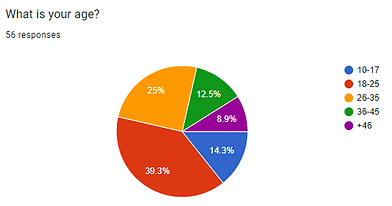
8
22
14
7
5
There's an overwhelming amount of men who responded to the questionnaire, meaning we're mainly getting responses from them. Because this is anonymous we can't be certain who answered what, but that's still something to keep in mind. For my previous units I don't target a specific gender so this usually isn't too bad of an issue, but I'm still slightly disappointed about how uneven it is

16
31
6
3
I don't usually do ethnicity questions either, but its interesting to see. Like with the age and gender questions, the results don't surprise me since Reddit is predominately filled with 18-25 year old white men. While the ages are very varied, the gender and ethnicity of the respondents aren't. I don't think we're really targeting a specific ethnicity with the short film though, so I don't think its actively bad rather than just something to take note of

8
33
6
3
6
An overwhelming majority of the respondents know who Wes Anderson is or at least one of his movies. This is very good as it means we're getting responses from people who actually know who he is or have at least watched/heard of his films, meaning we're more likely to get accurate and detailed responses

51
5

There were a lot of detailed responses, so much so that I had a bit of a hard time fitting them all into one image. It doesn't surprise me at all since I put this on a subreddit dedicated to Wes Anderson, so I imagine a lot of the more detailed responses are from that. In general all of them together list off: comedy, style, colour, cinematography, narrative/storytelling, music and iconic characters
The responses say they like how Anderson uses light humour in serious moments, which is something our short film was majorly inspired by. One of the responses goes into more detail about his comedy, mentioning there being a literal rhythm with his jokes that happens every 40 beats
When it comes to style, they're usually talking about the use of colour or his cinematography. Many say his visual style is distinct and one response mentions how there's an 'innocence/gentleness to his aesthetic and characters'. The short film we're making somewhat has that with the characters, the host faked their death to make the party more interesting and is sort of a people pleaser. Back to cinematography, some responses mention his symmetry and his camera movement. Anderson's cinematography is the main focus of his style other than the colours, so its definitely something we're going to put emphasis on in the film

There was a wide variety of different answers to this question with similar reasonings oddly enough. Some people say The Life Aquatic because the story is personal to them and others say Fantastic Mr Fox for the exact same reason. Since this is meant to be a subjective question, the diverse answers are good here. Out of all the responses, the three movies that are mentioned the most are Fantastic Mr Fox, The Grand Budapest Hotel and The Royal Tenenbaums
Fantastic Mr Fox is many peoples favourites because of its relatable characters, cinematography, comedy and animation. A response mentions that the cinematography is at its best with this film and really fits the stop motion animation. I obviously can't do stop motion, but I can take note of the cinematography in this film. I have watched the movie previously (although its been a long time) and I do remember there was a bit of slapstick and witty jokes in the film, I don't plan on doing much slapstick in my short film as I feel like Wes Anderson doesn't do it often but I can do the latter in the movie still
The Grand Budapest Hotel is mentioned for its fast pacing, visuals, cinematography and production design. The film has a grandness to it (its in the name) that can be in our film, the production design of the short film we're making is half inspired by how fancy everything looks in this film. The visuals won't be as boldly coloured as Budapest Hotel, but will still have its elements of colour in the set and costume design. Due to the strict time we're on the short film will have to be decently fast paced as well
The Royal Tenenbaums is a very personal film for most people who answered it. The film has an 'emotional punch' as well. Out of the three big films mentioned, this is the least the short film will have in common due to it focusing on being a comedy. Some also like it for the family theme it has, unfortunately this won't be in the short film we're making

Unlike the previous question, this mostly got similar answers. Majority either said they didn't know or said Bottle Rocket as it was the film that did the worst commercially and was his first film. In retrospect I'm not really a fan of how the question is phrased, we should've asked what the respondants least favourite film was instead of least successful
One of the responses mentions The French Dispatch because its three different storylines were hard to follow, this could be a trap we end up falling into with our short film if we aren't careful. Because the three main characters in the short film are all entertwined in the same storyline we should avoid this problem though

Most of the answers here were also the same: muted colours, symmetry, comedy, good cinematography, iconic characters and just fun. Majority of the answers were planning to be included anyway (symmetry, colours, cinematography), but there are also some things the responses mention that are new. A response mentions the characters reacting emotionally in a cartoonish way, the characters in the short film were originally based on different emotions (sad, happy and angry) and they are planned to be exaggerated characters
One of the responses talks about the characters still wearing regular clothes but it also feeling like a costume still. This is sort of planned to be in the short film already as the characters are invited to a fancy dinner party, so they'll be wearing more fancier clothing for the day. Another response also talks about the clothes being colour co-ordinated which was planned to happen since the third production meeting

Many of the answers say a comedic drama which is exactly what our short film will be, one even says a 'drama comedy crime mystery' and another saying its a serious situation in a comedic light. This is perfect as it means the genre that we're doing for our short film is something audiences would expect from him, which is what we're aiming for here. Other answers were romance, indie, adventure and fantasy

Similar to the previous question a lot of the answers go hand and hand with the concept of the short film, the last answer shown in the picture is literally the plot of it. This is reassuring for reasons listed above, but the answers also point to a problem that we haven't truly thought about yet. Some answers mention there should be both dramatic and comedic scenes, however doing them in the short film will be difficult without it feeling a bit tonally wrong. These answers made me realise that while we've thought a lot about the scenes in the film, I'm not sure if there's an even spread of dramatic scenes and comedy scenes throughout the short film
All and all this questionnaire has really reinforced the concept of the short film and proved that the narrative is a good fit for a Wes Anderson styled short film. Audiences would expect a comedic drama or a murder mystery from him, two things that will be in our short film. They also expect the same things we thought they would based on the research we did previously (symmetry, cinematography, usage of colour, ect.). Another thing this questionnaire has helped me with is realising the pitfalls in our short film, like possibly having too many character narratives to focus on or the short film leaning too heavily into one specific genre. I will definitely be bringing up these subjects in our next production meeting
Daily Diary 29/09
Today we had to make and do a pitch for our short film, we also started on our questionnaire analysis. By Tuesday I have to finish the questionnaire analysis, do research on locations and fill out the proposal for the short film. Doing a pitch helps us realise where the short films weaknesses are and the questionnaire analysis helps with finding out what audiences like about Wes Anderson films so we can put it in our short film
I was really disappointed with the pitch but now that its been a few hours and I've rewatched the pitch, I see that it wasn't as bad as I was making it out to be previously. We did okay but compared to the other team and what I did previously it was definitely a downgrade. While we were making the slides I felt the urge to just make them myself, but I recognised that wouldn't be working as a team so I tried to help passively instead
The last time I really worked in a four person group was for the music video and I've obviously majorly improved since then because that was the first unit. Because of that I feel like its a little redudant to say I've improved on my teamworking skills since then but its still something to note since I was thinking about it
As mentioned before, I posted the questionnaire on r/WesAnderson. Someone replied that they'd like to see the short film when its done, so I at least have one person to get audience feedback from if they follow through with it. I could also post the short film on the subreddit in general, although that most likely wouldn't get me responses that are too detailed

Bibliography
BBC. (2019) Movies With Ali Plumb. Available at: https://www.bbc.co.uk/iplayer/episode/p07jzhgw/movies-with-ali-plumb-movies-that-made-me-quentin-tarantino. Accessed at: 13.09.22
Bhattacharya, S. (2004) Mr Blonde's ambition. Available at: https://www.theguardian.com/film/2004/apr/18/features.magazine. Accessed at: 10.09.22
Business Bliss Consultants FZE. (2018) Quentin Tarantino Auteur Theory. Available from: https://ukdiss.com/examples/auteur-theory-quentin-tarantino.php. Accessed 06/09/22
Byrne, J. (2013) Kathryn Bigelow Auteur. Available at: https://engl245umd.wordpress.com/2013/11/18/kathryn-bigelow-auteur/. Accessed at: 20.09.22
Cameron, G. (2022) What People Said About Working With Quentin Tarantino. Available at: https://www.ranker.com/list/colleagues-describe-quentin-tarantino/gordon-cameron. Accessed at: 15.09.22
Cameron-Dow, G. (2020) Is Wes Anderson an auteur?. Available at: https://gcamerondow.medium.com/is-wes-anderson-an-auteur-bca6894993a1. Accessed at: 20.09.22
Channel 4 News. (2013) Quentin Tarantino interview: 'I'm shutting your butt down!'. Available at: https://www.youtube.com/watch?v=GrsJDy8VjZk. Accessed at: 13.09.22
Cultural Reader. (Year unknown) Short summary: Death of the Author - Roland Barthes. Available at: https://culturalstudiesnow.blogspot.com/2017/02/roland-barthes-death-of-author-summary.html. Accessed at: 07.09.22
Gaine, V. (2019) New Action Realism - A Companion to the Action Film. Available at: https://onlinelibrary.wiley.com/doi/abs/10.1002/9781119100744.ch15. Accessed at: 20.09.22
Gaine, V. (2021) Kathryn Bigelow: new action realist. Available at: https://www.tandfonline.com/doi/abs/10.1080/17400309.2021.1949957. Accessed at: 20.09.22
Glosbe. (Year unknown) closing scene. Available at: https://glosbe.com/en/en/closing%20scene. Accessed at: 21.09.22
Grace, Z. (2022) Tarantino Movie Fan Theories That Could Actually Be True. Available at: https://www.looper.com/152819/tarantino-movie-fan-theories-that-could-actually-be-true/. Accessed at: 12.09.22
Hardisty, M. (2020) Danny Boyle: Auteur?. Available at: https://morganhardistyfilmstudiesblog.wordpress.com/2020/03/13/danny-boyle-auteur/. Accessed at: 20.09.22
Hellerman, J. (2022) Tarantino Is So Secretive About His Final Film, Samuel L. Jackson Doesn't Know if He Has a Role. Available at: https://nofilmschool.com/tarantino-final-film-mystery. Accessed at: 16.09.22
Hirschberg, L. (1994) Tarantino Bravo. Available at: https://archive.vanityfair.com/article/1994/7/tarantino-bravo. Accessed at: 15.09.22
IMDb. (Year unknown) Afred Hitchcock. Available at: https://www.imdb.com/name/nm0000033/. Accessed at: 16.09.22
IMDb. (Year unknown) Danny Boyle. Available at: https://www.imdb.com/name/nm0000965/. Accessed at: 20.09.22
IMDb. (Year unknown) Harvey Keitel. Available at: https://www.imdb.com/name/nm0000172/. Accessed at: 10.09.22
IMDb. (Year unknown) Kathryn Bigelow. Available at: https://www.imdb.com/name/nm0000941/. Accessed at: 20.09.22
IMDb. (Year unknown) Samuel L. Jackson. Available at: https://www.imdb.com/name/nm0000168/. Accessed at: 10.09.22
IMDb. (Year unknown) Samuel L. Jackson. Available at: https://www.imdb.com/name/nm0000168/. Accessed at: 16.09.22
IMDb. (Year unknown) Tim Roth. Available at: https://www.imdb.com/name/nm0000619/. Accessed at: 15.09.22
IMDb. (Year unknown) Wes Anderson. Available at: https://www.imdb.com/name/nm0027572/. Accessed at: 20.09.22
Kozlov, V & Holdsworth, N. (2019) Quentin Tarantino Says His 10th and Final Film Will Be “Epilogue-y”. Available at: https://www.hollywoodreporter.com/news/general-news/quentin-tarantino-says-his-10th-final-film-will-be-epilogue-y-1230249/. Accessed at: 15.09.22
Lannom, S. (2021) The Wes Anderson Style Explained: Ultimate Guide. Available at: https://www.studiobinder.com/blog/wes-anderson-style/. Accessed at: 25.09.22
Lewis, R. (2012) Quentin Tarantino discusses the music of ‘Django Unchained’. Available at: https://www.latimes.com/entertainment/music/la-xpm-2012-dec-25-la-et-ms-quentin-tarantino-django-unchained-music-soundtrack-streaming-20121224-story.html. Accessed at: 12.09.22
MasterClass. (2022) Film 101: What Is an Auteur? Learn About Auteur Theory. Available at: https://www.masterclass.com/articles/film-101-what-is-an-auteur. Accessed at: 06.09.22
Morgan, Z. (2021) Unpacking Wes Anderson's Cinematic Style. Available at: https://www.curzon.com/journal/unpacking-wes-anderson-s-cinematic-style/. Accessed at: 21.09.22
Movieclips. (2016) Moonrise Kingdom (4/10) Movie CLIP - I'm On Your Side (2012) HD. Available at: https://www.youtube.com/watch?v=5bBti58el_g. Accessed at: 21.09.22
MrHecker. (2021) Tarantino criticizes Roger Deakins & Digital Cinematography. Available at: https://www.youtube.com/watch?v=FvJAABBdMXc. Accessed at: 16.09.22
Murphy, S. (2012) Tableaux Viviant: History and Practice. Available at: https://artmuseumteaching.com/2012/12/06/tableaux-vivant-history-and-practice/. Accessed at: 21.09.22
MyTutor. (Year unknown) What is "The Death of the Author" and why has it been so influential in literary criticism?. Available at: https://www.mytutor.co.uk/answers/37763/A-Level/English/What-is-The-Death-of-the-Author-and-why-has-it-been-so-influential-in-literary-criticism/. Accessed at: 07.09.22
Ninvoid99. (2014). The Auteurs: Kathryn Bigelow. Available at: https://cinemaaxis.com/2014/01/22/the-auteurs-kathryn-bigelow/. Accessed at: 20.09.22
Peary, G. (2013) Quentin Tarantino: Interviews, Revised and Updated. [Ebook] Univ. Press of Mississippi. Accessed at: 14.09.22
PopMatters Staff. (2003) ‘The Cinema of Kathryn Bigelow – Hollywood Transgressor’. Available at: https://www.popmatters.com/cinema-of-kathryn-bigelow-2496246013.html. Accessed at: 20.09.22
Quora. (Year Unknown) How do I slowly increase music volume in Adobe Premiere Pro (read description)?. Available at: https://www.quora.com/How-do-I-slowly-increase-music-volume-in-Adobe-Premiere-Pro-read-description. Accessed at: 20.10.22
Redmond, S & Batty, C. (2014) Wes Anderson is one of cinema’s great auteurs: discuss. Available at: https://theconversation.com/wes-anderson-is-one-of-cinemas-great-auteurs-discuss-25198. Accessed at: 20.09.22
Rotten Tomatoes. (Year unknown) Brian De Palma. Available at: https://www.rottentomatoes.com/celebrity/771481922. Accessed at: 15.09.22
Seal, M. (2013) Cinema Tarantino: The Making of Pulp Fiction. Available at: https://www.vanityfair.com/hollywood/2013/03/making-of-pulp-fiction-oral-history. Accessed at: 08.09.22
SearchlightPictures. (2014) THE GRAND BUDAPEST HOTEL: "Interview with Zero". Available at: https://www.youtube.com/watch?v=fmH0tKU0B4g. Accessed at: 21.09.22
Smith, G. (1994) Interview: Quentin Tarantino. Available at: https://www.filmcomment.com/article/quentin-tarantino-interviewed-by-gavin-smith/. Accessed at: 14.09.22
Soroka, C. (2020) Danny Boyle, Auteur?. Available at: https://caitlinsorokasfilmstudiesblog.wordpress.com/2020/03/11/danny-boyle-auteur/. Accessed at: 20.09.22
StudioBinder. (2021) The Wes Anderson Style Explained — The Complete Director's Guide to Wes Anderson's Aesthetic. Available at: https://www.youtube.com/watch?v=q45m7RYy7-4. Accessed at: 21.09.22
The Final Cut. (2021) The Royal Tenenbaums - Kids are alright. Available at: https://www.youtube.com/watch?v=Q5Hbs0s6_sQ. Accessed at: 21.09.22
The Guardian. (2022) ‘Godard shattered cinema’: Martin Scorsese, Mike Leigh, Abel Ferrara, Claire Denis and more pay tribute. Available at: https://www.theguardian.com/film/2022/sep/14/godard-shattered-cinema-martin-scorsese-mike-leigh-abel-ferrara-luca-guadagnino-and-more-pay-tribute. Accessed at: 15.09.22
The Howard Stern Show. (2017) Jamie Foxx Recalls Quentin Tarantino's Directing Style on "Django Unchained". Available at: https://www.youtube.com/watch?v=7K8j55V3Lvw. Accessed at: 15.09.22
TV Tropes. (Year unknown) Death of the Author. https://tvtropes.org/pmwiki/pmwiki.php/Main/DeathOfTheAuthor. Accessed at: 07.09.22
University of Cambridge. (2014) Skulls in print: scientific racism in the transatlantic world. Available at: https://www.cam.ac.uk/research/news/skulls-in-print-scientific-racism-in-the-transatlantic-world. Accessed at: 12.09.22
Yardbarker. (2022) Every cameo that Alfred Hitchcock made in his films. Available at: https://www.yardbarker.com/entertainment/articles/every_cameo_that_alfred_hitchcock_made_in_his_films/s1__34868963. Accessed at: 16.09.22
Newby, R. (2019) ‘Once Upon a Time in Hollywood’ and the End of Tarantino. Available at: https://www.hollywoodreporter.com/movies/movie-news/once-a-time-hollywood-end-tarantino-1227953/. Accessed at: 16.09.22